Enterprise Solutions · Architecture
Enterprise On-Premises to Cloud Migration: The 7 Rs
An enterprise framework for assessing on-premises workloads, selecting among the 7 Rs, and governing migration waves from discovery through operational handover.
Document class: Enterprise migration architecture reference model Normative terms: MUST, MUST NOT, SHOULD, SHOULD NOT, and MAY are requirements levels. Applicability: Rationalization and migration of applications, data platforms, infrastructure, and supporting services from enterprise data centres or hosted environments to public cloud, private cloud, SaaS, or a governed hybrid state. Exception process: Deviations require a documented risk assessment, compensating controls, named risk owner, and expiry date.
| Control field | Value |
|---|---|
| Document ID | ES-12 |
| Owner | Cloud Center of Excellence |
| Review cycle | At least annually and after material changes to cloud strategy, regulation, migration tooling, or target platforms |
| Evidence | Portfolio inventory, disposition decisions, dependency map, business case, migration plan, approvals, test results, cutover record, and operational acceptance |
Decision in brief: Assign a documented disposition to every workload before committing it to a migration wave. Use retire, retain, rehost, relocate, repurchase, replatform, and refactor/re-architect as portfolio choices. Select based on outcomes, risk, dependencies, cost, and time; the labels are not a maturity ladder.
Executive summary
The 7 Rs provide a common vocabulary for deciding what should happen to each application or workload during cloud adoption. They include choices that do not move a workload (retire and retain) and several ways to move or replace it. Decide at a defined workload boundary, not automatically at the server level: an application, database, shared service, and its data may take different paths when dependencies and ownership permit.
Maintain one accountable owner and one current disposition for every in-scope workload. Each decision SHOULD state its rationale, target, dependencies, data treatment, controls, cost assumptions, migration or exit trigger, and review date. Revisit it when discovery reveals constraints or the business case changes.
The 7 Rs
| Strategy | Meaning and typical fit | Trade-offs and required controls |
|---|---|---|
| Retire | Decommission an obsolete, duplicated, unused, or low-value application. Archive records only as required. | Confirm consumers and interfaces; approve archival or deletion; revoke identities, routes, and licenses; update CMDB/contracts; monitor for missed dependencies. |
| Retain | Keep the workload in its current location for now, as a deliberate hybrid or deferred-migration decision. | Appropriate for regulatory or latency constraints, contractual commitments, unresolved dependencies, low migration value, or an imminent replacement. Record owner, controls, review date, and exit trigger; it is not an unmanaged exception. |
| Rehost | Move with little or no application change (“lift and shift”). Useful for a fast data-centre exit, stable applications, or limited modernization windows. | Technical debt and operating costs may remain. Validate licensing, sizing, backup, recovery, security baseline, performance, and post-move optimization. |
| Relocate | Move a platform or group of systems to cloud infrastructure with minimal application-layer changes, commonly through a compatible hypervisor/platform migration path. | Confirm compatibility, capacity, networking, storage, licensing, tooling, and support boundaries. State the supported platform path; this is not simply copying a VM image. |
| Repurchase | Replace a custom or legacy application with another product, often SaaS or a commercial platform. | Assess process fit, data portability, identity, integrations, residency, availability, lock-in, licensing, service levels, contract exit rights, adoption, and legacy shutdown. |
| Replatform | Move while making bounded changes to use a managed platform or improve operations, without fundamentally redesigning the application. Examples include managed databases, runtimes, or limited containerization. | Validate compatibility, service limits, performance, observability, backup/restore, resilience, identity, and operations. Test application and platform together. |
| Refactor / re-architect | Substantially change code, components, or architecture to achieve cloud-native or business goals such as elasticity, resilience, or faster product delivery. | Highest change and test demand. Fund redesign, data/interface changes, security review, skills, parallel operation, and rollback/coexistence. Deliver incrementally against measurable acceptance criteria. |
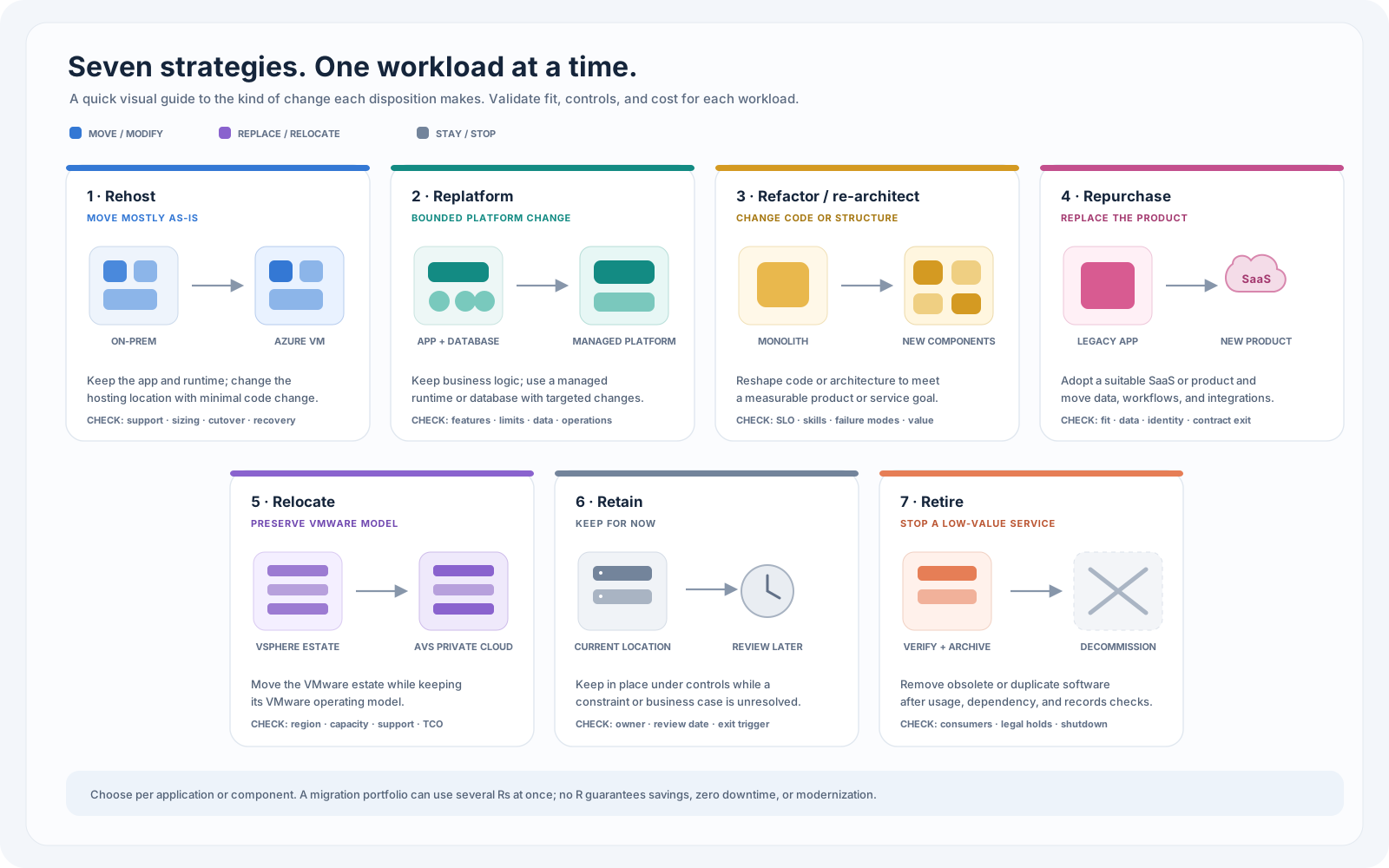
Visual guide: each card is a conceptual comparison; use the detailed guidance below for workload-specific decisions.
Taxonomy note: The 7R model used here follows the AWS migration-strategy vocabulary: retire, retain, rehost, relocate, repurchase, replatform, and refactor/re-architect. Microsoft's current Cloud Adoption Framework presents eight dispositions: retire, rehost, replatform, refactor, rearchitect, rebuild, replace, and retain. The models overlap but are not identical: repurchase is broadly comparable to replace; refactor and rearchitect are separate in the CAF but combined in this 7R shorthand; relocate is a distinct VMware-oriented pattern here; rebuild is an additional option in the CAF model. Do not describe either list as the universal taxonomy. Record the framework and definitions used in each portfolio decision.[R1][R2]
Each recommendation SHOULD answer five questions: why the business needs a change; why this disposition is better than viable alternatives; what the source and target architectures, dependencies, and service ownership are; how data, identity, network, deployment, testing, cutover, and rollback will work; and what evidence-based costs, risks, service objectives, and acceptance measures apply.
Quick comparison and field cheat sheet
Use this comparison to shortlist options, not to rank them. “Fast” and “high effort” are relative tendencies; workload constraints, data movement, and vendor dependencies can change the result.
| Strategy | Definition | Best fit | Main objective | Typical speed / effort |
|---|---|---|---|---|
| Retain | Keep the system in its current environment for now. | Workloads not ready or worth moving yet, or facing compliance, latency, contractual, or dependency constraints. | Prioritize migration-ready workloads and reduce risk from moving systems before they are ready. | Fast disposition decision; existing operations continue. |
| Retire | Decommission a system no longer used or creating business value. | Obsolete, duplicated, or unused applications, databases, and services, after dependency and records checks. | Reduce complexity, maintenance, and cost before or during migration. | Often quick after consumer, legal-hold, and archival checks. |
| Rehost | Move to cloud with little or no change to application code or architecture (“lift and shift”). | Stable workloads that must move quickly, have a firm time constraint, or need to reduce data-centre dependency. | Accelerate migration while limiting application change. | Often fastest migration; low-to-medium effort. |
| Relocate | Move workloads or virtual machines to a directly supported cloud environment while preserving a similar management model. | Virtualized estates needing migration without major application or operating-model changes; for VMware, confirm the supported target such as AVS. | Reduce migration risk and accelerate the move without major architectural changes. | Medium-to-high infrastructure and network effort; validate capacity, support, and TCO. |
| Repurchase | Replace the existing system with a product or SaaS solution. | Standard business capabilities where a supported product fits and customization is limited, or in-house maintenance is no longer cost-effective. | Reduce infrastructure, maintenance, and upgrade burdens. | Medium-to-high data, integration, and organizational change effort. |
| Replatform | Make bounded changes to use cloud services while keeping most application logic and design. | Valuable applications needing better performance or lower infrastructure-management effort, and compatible with managed services. | Improve performance, use cloud services, and achieve results sooner with controlled change. | Medium effort; validate compatibility and service limits. |
| Refactor / re-architect | Redesign code or system structure for a cloud-native architecture and new capabilities. | Strategic systems such as core operations, customer platforms, or data platforms that must support long-term growth. | Build capabilities, support scalability, and enable advanced analytics or AI where justified. | Usually the longest path and highest engineering effort. |
Match the disposition to the business outcome
Use the business driver to form a shortlist, then test each option against hard gates, whole-life cost, workload dependencies, and operational readiness. These are starting hypotheses, not guaranteed outcomes.[R6]
| Business outcome | Strategies to evaluate first | Validate before choosing |
|---|---|---|
| Meet a data-centre exit or lease deadline | Rehost; Relocate for qualifying VMware estates; Retire workloads with no ongoing value | Vendor/platform support, dependency groups, cutover window, rollback, and dual-run cost |
| Reduce platform maintenance | Replatform; Repurchase | Feature fit, identity and data controls, service limits, contract terms, and actual support responsibilities |
| Improve scaling, release speed, or resilience | Refactor / re-architect; sometimes Replatform | Baseline SLOs, target architecture, engineering capacity, failure modes, and measurable benefit |
| Eliminate cost and exposure from unused systems | Retire | Confirm usage, downstream consumers, legal holds, and records obligations |
| Respect a current technical or regulatory constraint | Retain with a review trigger | Owner, ongoing security/support status, hybrid dependencies, and reassessment date |
One-minute disposition cheat sheet
Fast recall: eliminate it → Retire; defer with accountability → Retain; move largely as-is → Rehost; preserve VMware → Relocate; buy a replacement → Repurchase; move to a managed runtime → Replatform; change code or architecture for a measurable outcome → Refactor/re-architect. Always check hard gates before choosing.
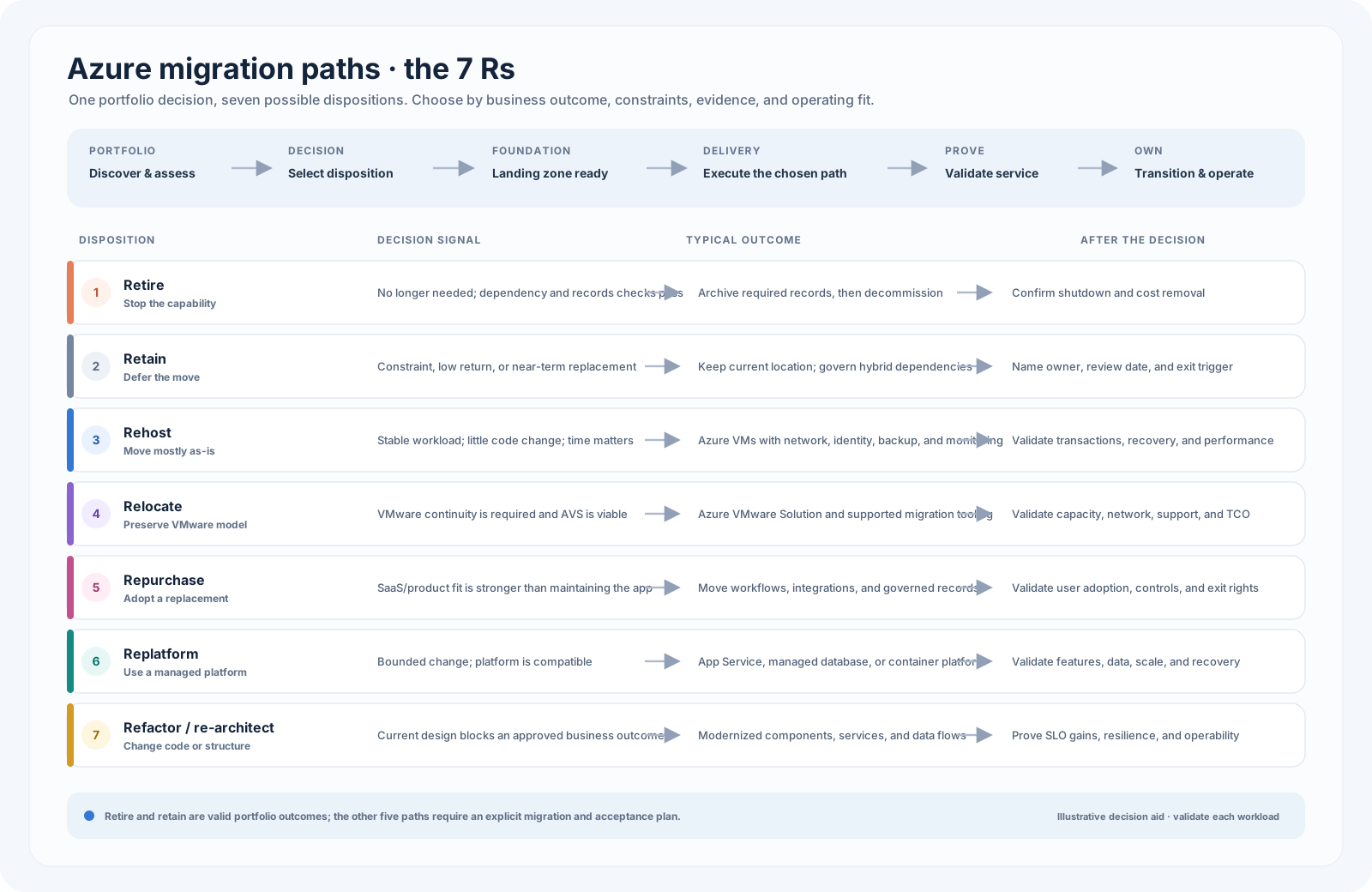
The diagram is a field reference; confirm each workload’s constraints, dependencies, and support requirements before selecting a path.
Worked examples for each R
The following are hypothetical enterprise scenarios, not documented customer deployments or guaranteed recommendations. Use them to see how a business driver, evidence, and control shape each disposition.
| Strategy | Illustrative scenario | Decision evidence and control |
|---|---|---|
| Retire | A department still hosts a reporting application whose reports have been replaced by a governed enterprise analytics service. | Confirm usage with report owners and downstream consumers; approve records retention; export required history; disable the application in a monitored window; then revoke identities and remove infrastructure after no missed dependency appears. |
| Retain | A factory control workload depends on vendor-certified hardware and response times that cannot be met over the available cloud connection. | Measure latency and confirm vendor and safety requirements. Keep it on-premises with a named owner, funded support and recovery controls, governed connectivity, and a review trigger for hardware refresh or vendor support changes. |
| Rehost | A stable internal document-processing service must leave a leased data centre before its exit date, while a code change would add schedule risk. | Confirm OS and vendor support, dependencies, licensing, capacity, security, backup, and recovery. Test migration and cutover on a representative instance; record remaining technical debt and a funded post-move review. |
| Relocate | A VMware estate relies on VMware-specific operations and integrations, and the organization wants to preserve that management model during a data-centre exit. | Compare AVS with native Azure alternatives. Validate workload eligibility, capacity, region availability, network design, licensing, support lifecycle, migration tooling, and whole-life cost before approving the target. |
| Repurchase | A custom expense-management application has become costly to maintain, and a SaaS product appears to cover the organization’s standard approval workflows. | Run a fit-gap and contract review; validate SSO, audit, retention, integrations, data export, privacy, and exit rights; pilot user adoption; reconcile migrated records before retiring the custom system. |
| Replatform | An IIS business application is stable but its VM-hosted runtime and database require substantial patching and backup administration. | Test a bounded move to managed hosting and database services. Verify authentication, file access, scheduled jobs, database feature compatibility, private connectivity, performance, backup/restore, and operational ownership while preserving core business behavior. |
| Refactor / re-architect | A customer-facing application’s tightly coupled components make releases risky and prevent one high-demand capability from scaling independently. | First confirm the bottleneck with release and service telemetry. Modernize a bounded capability, define its API/data ownership and failure behavior, deploy gradually, and compare release lead time, reliability, and scaling against agreed baselines before expanding the redesign. |
The selected R can differ by component within one business service. These examples are starting hypotheses: apply the hard gates, compare viable alternatives, and document the evidence and approval for the actual workload.
Azure strategy selection
Use this screening sequence to narrow options, then validate the result with business and technical owners. It is guidance, not an automatic decision algorithm.
Hard exclusion gates
Evaluate mandatory constraints before weighted scoring. Exclude or remediate an option that fails a gate; a high score cannot waive a failed requirement.
| Gate | Evidence to collect | Example failure |
|---|---|---|
| Regulation and residency | Applicable obligations, data-flow map, approved Azure region | Target cannot meet mandatory residency or control requirements |
| Product and vendor support | Vendor support matrix or written confirmation | Vendor does not support the target OS, PaaS, or virtualization platform |
| OS and runtime feasibility | Version, architecture, driver, feature, and hardware assessment | Kernel driver or hardware dongle cannot run on the target |
| RTO, RPO, and availability | Approved business targets and tested design | Replication cannot meet the maximum data-loss objective |
| Data and integration fidelity | Schemas, interfaces, batch schedules, and reconciliation plan | Critical workflow cannot be represented in a SaaS replacement |
| Connectivity and latency | Measured p95/p99 latency, routes, DNS, and firewall paths | Required hybrid round trip exceeds application tolerance |
| Financial and contract limits | Licensing, SaaS contract, reserved capacity, and AVS quote | Target exceeds the approved financial envelope |
| Security and operations | Threat model, identity, logging, backup, patching, and owners | No approved means to meet the security baseline |
Azure target patterns and strategy procedures
Azure services below are candidate patterns; check current region, source-platform, licensing, and migration-path support before approval.
| Strategy | Candidate Azure outcome | Selection and implementation emphasis |
|---|---|---|
| Rehost | Azure Virtual Machines, managed disks, VNet/NSG, Azure Backup, Azure Monitor | Fit fixed exit dates and stable, supported workloads. Capture dependency and utilization baselines; right-size; design DNS, identity, egress, zones, and backup; run an isolated test migration; agree synchronization, traffic cutover, rollback thresholds, and source shutdown. Expect OS patching and technical debt to remain. |
| Relocate | Azure VMware Solution (AVS) with supported VMware migration tooling such as HCX where applicable | Use only when VMware-level continuity has material value and AVS capacity, region, support, networking, licensing, and economics are validated. Azure Migrate can support assessment; it is not itself the VM-migration mechanism into AVS. Distinguish AVS from conversion to native Azure VMs. |
| Replatform | App Service, Azure SQL Database/Managed Instance, Azure Database for PostgreSQL, Azure Files, or a managed container platform | Preserve business behavior while reducing platform operations. Test runtime, IIS modules, Windows authentication, file access, SQL Agent/CLR/linked-server and cross-database needs, private networking, backup, scaling, and service limits. Do not assume SQL Managed Instance is a drop-in replacement for every SQL Server workload. |
| Refactor / re-architect | App Service, Container Apps, Functions, API Management, Service Bus, Event Grid, managed data services, Key Vault, App Configuration, Application Insights | Tie engineering work to measurable outcomes and SLOs. Start with a bounded vertical slice; define service and data ownership; implement idempotency, timeouts, retries, identity, and tracing; test partial failures; use staged traffic shifts. Choose AKS only when Kubernetes capabilities justify its operational burden. |
| Repurchase | Dynamics 365, Microsoft 365, or a suitable third-party SaaS product | Perform fit-gap and contract reviews; map and cleanse data; validate SSO, provisioning/SCIM where supported, APIs, retention, audit, DLP, residency, rate limits, user adoption, and vendor exit/export rights. Migrate processes and records, not a server image. |
| Retain | Current on-premises platform with governed hybrid connectivity; Azure Arc for supported management scenarios | Record the owner, reason, classification, support status, ongoing cost, security and recovery controls, cloud dependencies, and reassessment date/trigger. Azure Arc is a management option, not a migration engine. Fund continued operations. |
| Retire | Archive required records, then decommission and remove access/resources | Validate usage with business owners; trace scheduled jobs and consumers; obtain records/legal approval; export required data; disable and observe; revoke identities, secrets, DNS and network rules; update CMDB/contracts; verify costs stop. |
For any pattern, acceptance requires supported design, functional and data validation, approved security controls, service-level and recovery evidence, operational ownership, and cost within an agreed tolerance. For modernization, success means measured improvement in the selected business or service outcome—not simply adopting containers or cloud services.
Azure service and tooling map
| Phase or requirement | Azure/Microsoft option | Critical validation |
|---|---|---|
| Discovery and assessment | Azure Migrate | Supported source types, OS/guest access, inventory and dependency coverage |
| Native VM migration | Azure Migrate: Migration and modernization | Replication method, target limits, and migration support matrix |
| Database migration | Azure SQL migration assessment and supported migration methods | Feature compatibility, downtime, and transactional consistency |
| Web migration | App Service migration tooling where supported | Runtime/framework, OS dependencies, and networking |
| Landing zone | Management groups, subscriptions, Azure Policy, RBAC/PIM | Hierarchy, permissions, policy assignments, and exclusions |
| Hybrid network | ExpressRoute or site-to-site VPN, VNet, DNS Private Resolver | Routes, DNS, firewall, asymmetric routing, and capacity |
| Network security | NSGs, Azure Firewall, Private Link | Required paths, and managed-service data/control-plane access |
| Identity and secrets | Microsoft Entra ID, AD DS where needed, managed identities, Key Vault | Kerberos/LDAP/domain-join needs, rotation, access model, and private DNS |
| Monitoring and security posture | Azure Monitor, Log Analytics, Application Insights, Defender for Cloud | Collection cost, alert ownership, and coverage |
| Backup and recovery | Azure Backup, Azure Site Recovery, application-native tools | Service-specific support and successful recovery tests |
| Infrastructure as code | Terraform, Bicep, CI/CD | Policy checks, state, drift, and environment parity |
| Finances | Azure pricing calculator and cost-management capabilities | Migration, dual-run, licensing, data transfer, logging, and DR costs |
Landing-zone readiness
Before a production wave, confirm subscription and management-group structure, policy, tags, budgets, target region and residency; validate CIDR overlap, routes, DNS in both directions, firewall paths and private endpoint resolution; test Entra/AD authentication, privileges and workload identities; operationalize logging, threat detection, backup, restore and patch management; test infrastructure-as-code deployment and emergency access; and agree platform/application ownership boundaries.
Portfolio discovery and decision scoring
Extend the portfolio record with host/VM and hypervisor, OS/runtime/database, CPU and memory baselines, disk capacity/IOPS, network throughput, service hours, SLO, scheduled jobs, authentication model, license/support status, evidence confidence, and candidate wave. Sample peaks, month-end, seasonal work, and unusual operating periods rather than sizing from a quiet day. Map application dependencies such as database links, file shares, SMTP, AD/DNS, certificates, SFTP, schedulers, firewalls, and downstream consumers—not only VM-to-VM traffic.
Interview business and technical owners about business value, accountability for downtime, modifiability and vendor support, data size/consistency/retention/residency, integrations, identity, SLO/RTO/RPO, fully loaded costs, deadline, and team skills. Record rejected alternatives and assumptions.
After hard gates pass, a weighted scorecard MAY compare viable options. Example weights are business fit/value 20%, technical compatibility 20%, security/compliance 20%, three-to-five-year TCO 15%, delivery speed/risk 15%, and operations/resilience 10%. Score each dimension from 1 (poor) to 5 (strong), cite evidence and confidence, then calculate SUM(weight_fraction × score). The result supports discussion; uncertainty, sensitivity, and authorized approval still govern the decision.
An architecture decision record SHOULD capture status/date, business and technical owners, disposition and driver, current architecture/dependencies, required controls and SLO/RTO/RPO, alternatives and hard-gate results, score evidence/confidence, TCO range and sensitivity, risks, proof-of-concept evidence, migration wave/cutover/rollback, approval, and review trigger.
Azure reference architectures and illustrative cases
These are logical patterns, not deployment-ready diagrams. Production designs require detailed network, identity, security, resilience, and ownership views.
Rehost: VMware to native Azure VMs
The hosting changes while application architecture and OS administration mostly remain. Validate hybrid DNS, data consistency, licensing, and routes before changing endpoints.
Replatform: IIS and SQL Server to managed services
Validate runtime/authentication, database features, private data paths, and the migration method before choosing the managed target.
Re-architect: monolith to independently operated components
This introduces asynchronous boundaries and possibly separate data ownership. Implement idempotency, distributed tracing, consistency rules, dead-letter handling, and controlled rollout. AKS is an option only when operational requirements justify it.
VMware relocation: vSphere to AVS
The VMware operating model remains; this is not conversion to native Azure VMs. Confirm supported tooling, network topology, region/host capacity, lifecycle, and contracts before committing.
Illustrative scenarios SHOULD compare options rather than prescribe one answer. A three-tier IIS/.NET/SQL service with a datacenter deadline may rehost initially only if validation supports it; prototype managed targets without assuming a two-step move is always cheaper. A mixed 200-VM VMware estate may combine AVS for vendor-constrained systems, native VM rehost for compatible systems, and retirement for obsolete workloads; compare actual quotes and dependency evidence. A customer API with release and scaling bottlenecks may modernize one bounded batch workflow first, and retain a simpler App Service monolith if that already meets its SLO. These are hypothetical exercises, not customer results.
Decision principles
- Start with business disposition: confirm the capability is needed, its owner, and the outcome before selecting a technical pattern.
- Assess the whole service: map application components, data, batch jobs, identity, integrations, network flows, shared infrastructure, vendors, and operations. Record evidence and confidence for dependencies.
- Choose the smallest strategy that achieves the outcome: avoid refactoring during a time-critical data-centre exit unless required; do not rehost into an unsupported or noncompliant target.
- Treat the R as a revisable decision: reassess when discovery, proof-of-concept results, cost, or risk changes an assumption; preserve decision history.
- Plan the target operating model: establish landing-zone controls, identity, network, logging, policy, backup, incident response, cost ownership, and support before production cutover.
- Use whole-life economics: include migration, parallel running, modernization, licenses, egress, support, skills, resilience, and exit costs. Cloud adoption does not guarantee savings.
Portfolio assessment and decision record
Maintain a canonical portfolio inventory keyed by a stable workload ID. Capture at least:
- capability, service tier, owner, users, criticality, lifecycle, and contracts;
- components, versions, hosting, utilization, growth, interfaces, and upstream/downstream dependencies;
- data classification, residency, retention, recovery objectives, volume, change rate, and transfer constraints;
- identity, privileged access, trust boundaries, network paths, certificates, secrets, vulnerabilities, and support status;
- service levels, observability, backup/restore evidence, incident history, skills, and operational readiness;
- current and target costs, licensing, effort, parallel-run duration, and cost uncertainty;
- selected R, rationale, decision owner, confidence, target pattern, assumptions, risks, approvals, review date, and reconsideration trigger.
Create a decision record for each workload or governed group, naming business and technical owners. A proposed strategy without dependency evidence or a viable target remains unassessed, not wave-approved. Combine discovery tooling, configuration data, network telemetry, interviews, and utilization; no single inventory source is complete.
Migration lifecycle and wave controls
Assess and rationalize
Set scope and success measures, discover the estate, define workload boundaries, map dependencies, find unsupported components, and assign preliminary Rs. Challenge duplicate and unused services before sizing migration capacity. Track unknowns as owned actions with due dates.
Mobilize the foundation
Prepare the landing zone and migration factory: account/subscription structure, identity and privileged access, connectivity, policy, logging, vulnerability management, backup/recovery, cost allocation, infrastructure as code, tooling, runbooks, and support. Confirm target services meet residency, security, availability, and operational needs.
Plan waves and prove patterns
Group workloads by dependency, business calendar, data movement, risk, and outage constraints, not server count alone. Sequence shared platforms before consumers. Use representative pilots. Define entry criteria, approvals, test evidence, cutover window, rollback threshold, communications, and accountable go/no-go authority for each wave.
Migrate and validate
Use repeatable, version-controlled automation and approved identities. Reconcile source and target inventories; validate configuration, security, data integrity, interfaces, performance, resilience, observability, and user journeys. Use parallel comparison or business reconciliation where needed. A successful copy or deployment is not service acceptance.
Cut over and stabilize
Execute a rehearsed cutover with explicit decision points. Keep a tested recovery route until the service owner accepts the target. Monitor service indicators and business transactions through a defined stabilization period. Stop or roll back when an agreed safety, data, or service threshold is breached.
Optimize, modernize, or exit
After stabilization, remove temporary access and migration infrastructure, right-size resources, and review cost and reliability. Close source systems only after business, audit, retention, and legal sign-off. Rehosted and relocated workloads SHOULD have a funded review date and follow-on improvement candidates.
Wave selection and standard runbook
Group by application and integration clusters, shared services, data gravity, consistency, maintenance windows, and business blackout periods—not by arbitrary VM counts. Sequence foundation services such as identity, DNS, licensing, databases, and monitoring before their consumers.
| Wave | Typical workload | Entry evidence | Exit evidence |
|---|---|---|---|
| Pilot | Representative, noncritical service | Landing zone, tests, and rollback ready | Migration pattern and operating model validated |
| Early | Low-coupling standard workloads | Automation and support teams ready | Acceptance signed; cost and performance measured |
| Intermediate | Multi-tier dependencies | End-to-end network/data plan tested | Integrations and reconciliation passed |
| Critical | Customer or mission-critical services | Rehearsals, DR proof, and executive/change approval | SLO, RTO/RPO, and cutover acceptance achieved |
| Cleanup | Approved decommission candidates | Retention and rollback periods approved | Source services and costs removed |
Before cutover: approve the window and acceptance measures; complete and prove a source backup restore; deploy target infrastructure with reviewed IaC and validated quotas; test routes, DNS, certificates, firewall, identity, and third-party paths; complete regression/load rehearsal; define replication-lag and reconciliation limits; name the rollback owner and decision time.
During cutover: apply the agreed application/data freeze; record the final synchronization checkpoint; route traffic to the target; verify TLS, DNS, identity, and business transactions; inspect errors, p95 latency, jobs, and downstream services; obtain the business decision at the planned checkpoint.
After cutover: monitor during agreed hypercare; validate target backup/restore and DR; compare cost and service metrics with baseline; update CMDB, owners, and runbooks; decommission only after retention, reconciliation, and rollback approvals.
Rollback must define who decides, the measured trigger, when rollback becomes unsafe, and how post-cutover writes will be reconciled. DNS reversal alone is not a database recovery plan. Test point-in-time restore, reverse replication, or application-level compensation as appropriate; explicitly state acceptable data loss and when forward-fix is safer.
Cross-cutting controls
- Security and compliance: Threat-model target changes, map controls, and apply least privilege, encryption, key ownership, vulnerability management, segmentation, logging, and evidence retention. Revalidate shared-responsibility assumptions for managed services and SaaS.
- Data: Classify before transfer. Approve transfer method, residency, encryption, reconciliation, retention, backup, restore, legal hold, and deletion. Keep source/target ownership clear during coexistence.
- Resilience: Define service-level recovery time and recovery point objectives. Demonstrate restore and failover at the target before acceptance.
- Change and continuity: Coordinate business calendars, users, vendors, support, integration owners, and regulatory approvals. Document coexistence and rollback for stateful systems.
- Financial management: Assign cost owners and tags, include shared-platform costs, compare actuals with forecasts, and track licensing and egress. Approve budget exceptions.
- Operations: Establish monitoring, alert routes, runbooks, on-call ownership, incident procedures, patching, capacity, service reporting, and knowledge transfer before handover.
Financial model and FinOps
Compare complete three-to-five-year target costs with a fully loaded on-premises baseline. Include assessment, remediation, migration, engineering and testing, training, dual-run, compute/platform, storage, network/egress, licenses, security, backup/DR, monitoring, support labor, and eventual exit/decommission. Use discounted cash flow if finance policy requires it; record discount and utilization assumptions. Model low/base/high utilization and uncertainty rather than presenting unsupported point estimates.
| Strategy | Main one-time cost | Recurring cost and sensitivity |
|---|---|---|
| Rehost | VM migration and testing | VM sizing, licensing, backup, and operations |
| Replatform | Platform changes and data migration | Service tier, database size, and feature remediation |
| Refactor/re-architect | Engineering and regression testing | Platform consumption, product engineering, and complex operations |
| Repurchase | Data/process transition and integration | User/feature subscriptions, API usage, and contract terms |
| Relocate | AVS setup and VMware migration | Host minimums/utilization, networking, and VMware lifecycle |
FinOps controls SHOULD right-size from representative peaks and percentiles; validate Azure Hybrid Benefit, reservations, or savings plans against current eligibility; include egress, logging, private networking, backup, firewall, and DR; model migration dual-run separately; tag by application, owner, environment, cost center, wave, and disposition; and reassess after production telemetry is available without compromising service or recovery.
Azure security and operational acceptance matrix
| Domain | Minimum evidence | Accountable parties |
|---|---|---|
| Identity | Least privilege, MFA/Conditional Access where applicable, workload identities, and secret rotation | IAM/security |
| Network | Route/DNS/firewall tests, private endpoint resolution, and outbound dependency checks | Network/platform |
| Data protection | Classification, residency, encryption, backup, and retention | Security/data owner |
| Threat protection | Defender/agent coverage, vulnerability and patch baseline | SecOps/platform |
| Reliability | Availability design, restore, and DR exercise against RTO/RPO | SRE/application owner |
| Observability | Dashboards, logs, traces, alerts, on-call routing, and ingestion cost | SRE/operations |
| Governance | Policy, tags, inventory, approvals, and exceptions | Cloud governance |
| Delivery | IaC quality, pipeline separation, deployment evidence, and rollback | Platform/application engineering |
| Financial | Budgets, cost allocation, and variance review | FinOps |
| Handover | SOP/runbook, owner roster, escalation, support contract, and support hours | Operations/business |
Moving from IaaS to PaaS or SaaS changes duties; it does not remove responsibility for identity, configuration, data, or application security. Document the responsibility boundary for the chosen service.
Governance, measures, and acceptance
A portfolio governance forum SHOULD review strategy coverage, dependencies, risk, cost, and wave readiness. Architecture/security reviewers approve material target deviations; business owners approve outcomes and downtime; platform owners approve landing-zone and operational controls. Exceptions MUST name compensating controls, an owner, and an expiry or review date.
Track workload coverage (owner, dependency map, approved R, current decision), retire/retain/migrate/repurchase outcomes and evidence, wave throughput and schedule variance, change failure/rollback/outage/incident rates, service acceptance, recovery tests, security findings, unresolved critical dependencies, actual versus forecast cost, parallel-run duration, realized benefits, and source assets decommissioned after exit criteria.
A workload is accepted only when its business owner confirms the outcome; target controls and operational responsibilities are evidenced; data and interfaces reconcile; recovery and support procedures work; authorized owners accept residual risks; and source disposition is recorded. The program is complete when temporary arrangements are removed or governed and retained workloads have review triggers.
Common anti-patterns
- Rehosting every workload can reproduce inefficient sizing and costly VM operations; do not call a hosting move application modernization.
- Assuming SQL Managed Instance, Azure SQL Database, or App Service has complete feature parity creates migration failures; perform compatibility and integration tests.
- Selecting AKS solely because it is cloud-native adds Kubernetes operating work; choose the simplest platform that meets requirements.
- Treating AVS relocation as native Azure VM rehost ignores different platforms, tooling, licensing, and capacity models.
- Migrating individual VMs without dependency groups, or postponing hybrid DNS design, can break hidden flows.
- Treating a healthy VM as proof of application readiness omits transactions, identities, scheduled jobs, monitoring, and recovery.
- Treating DNS rollback as complete recovery ignores database divergence and post-cutover writes.
- Using list prices without labor, dual-run, egress, security, DR, and contracts understates cost.
- Retaining without an owner/review trigger or retiring without records/dependency approval creates unmanaged risk.
- Letting a score override a failed mandatory gate or treating one 7R vocabulary as universal undermines governance.
Reusable migration templates
Disposition register fields: workload ID; business/technical owners; criticality; source platform; dependencies; data class; RTO/RPO; candidate and alternative strategies; hard-gate result; decision/reason/confidence; three-year TCO; wave; approval and review dates.
Readiness checklist:
- Business value and ownership verified; inventory and dependency graph reviewed.
- Azure region/service support and vendor compatibility verified.
- Target architecture, migration path, and security controls approved.
- Current and target three-to-five-year TCO validated.
- SLO, RTO/RPO, and data-reconciliation criteria recorded.
- Deployment, test, rollback, and incident ownership documented.
- Wave and change window approved.
Wave acceptance record: change ID and services; business owner/incident commander; decision checkpoints; replication and reconciliation evidence; functional/integration/security results; latency/error/batch comparison; backup/restore and DR evidence; RTO/RPO achieved; residual risks; rollback deadline/method; business and operations sign-off; source decommission authorization.
Executive decision record: workload and deadline; business driver; recommended disposition and rejected alternatives; target architecture; control gates and dependencies; upfront and three-/five-year TCO range; risks/mitigations; SLO/RTO/RPO acceptance; wave, cutoff, rollback, and decommission plan; accountable approver.
Adapt roles and approval thresholds to organizational governance. Business owners approve service outcomes and downtime; architecture/security approve material design and control deviations; data owners approve handling and retention; FinOps/procurement review economics and contracts; operations accept service support.
References
[R1]: https://docs.aws.amazon.com/prescriptive-guidance/latest/large-migration-guide/migration-strategies.html "AWS Prescriptive Guidance: About the migration strategies" [R2]: https://learn.microsoft.com/en-us/azure/cloud-adoption-framework/plan/select-cloud-migration-strategy "Microsoft Cloud Adoption Framework: Select your cloud migration strategies" [R3]: https://learn.microsoft.com/en-us/azure/migrate/ "Microsoft Azure Migrate documentation" [R4]: https://learn.microsoft.com/en-us/azure/cloud-adoption-framework/azure-vmware-solution/migration "Microsoft Cloud Adoption Framework: Migrate workloads to Azure VMware Solution" [R5]: https://learn.microsoft.com/en-us/azure/azure-vmware/ecosystem-migration-vms "Azure VMware Solution VM migration tool options" [R6]: https://suffescom.co.uk/blog/7-rs-cloud-migration-strategy "Suffescom: Introduction to the 7 Rs of Cloud Migration Strategy"